
How Accurate Fuel Data Can Improve Construction Project Budgeting
Accurate fuel data is crucial for construction project budgeting. It provides insights into fuel consumption and efficiency. Understanding fuel usage helps in precise budgeting and cost management. It allows project managers to allocate resources effectively.
Fuel efficiency stats can identify areas for improvement, leading to significant cost savings and better resource utilization. Implementing fuel monitoring systems reduces fuel theft and misuse — ensuring that every drop of fuel is accounted for. Accurate fuel data enhances decision-making and operational efficiency. It supports sustainable practices and compliance with environmental regulations.
The Importance of Accurate Fuel Data in Construction
Accurate fuel data is the backbone of efficient construction management. It offers a detailed view of fuel consumption patterns, providing insights essential for effective planning — and yet, many construction firms are still managing fuel with spreadsheets, slip tanks, and guesswork.
The result? Bloated budgets, undetected theft, and equipment sitting idle because no one knew fuel was running low.
Fuel data plays a critical role in identifying inefficiencies. It helps managers pinpoint areas where fuel is being wasted. With this information, teams can implement strategies to improve fuel efficiency and lower costs.
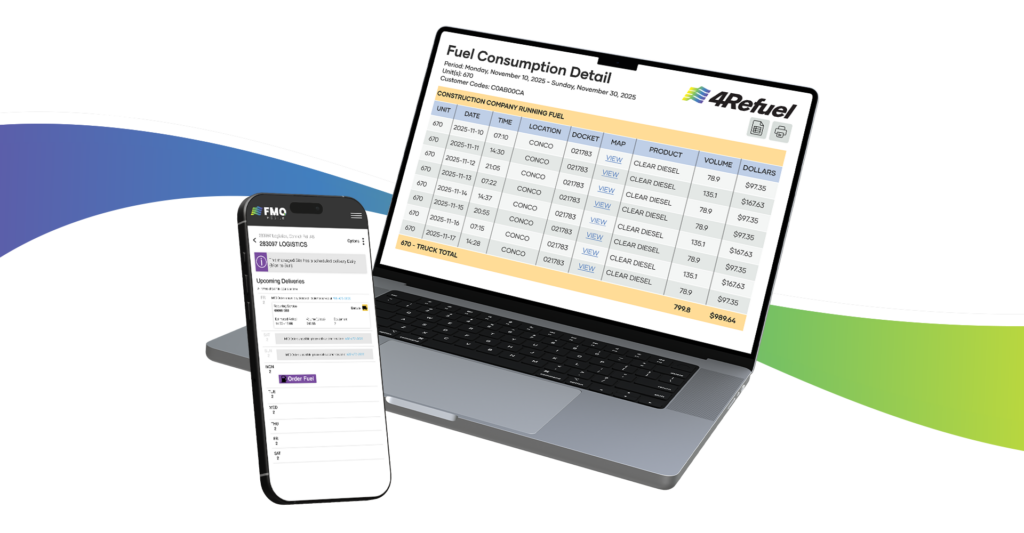
With a platform like 4Refuel's Fuel Management Online (FMO), construction managers gain access to comprehensive fuel economy metrics across every site, project, and piece of equipment — all in one place. That level of visibility transforms fuel from a line item you estimate into a cost you actually control.
Key benefits of accurate fuel data include:
Enhanced forecasting abilities
Reduced operational costs
Improved resource allocation across multiple job sites
A stronger position when negotiating fuel supply terms

How Fuel Consumption Data Impacts Project Budgeting
Fuel consumption data offers crucial insights that directly affect project budgeting. By understanding exact fuel usage, construction managers can create more precise budgets — preventing the unexpected overruns that derail project finances.
With 4Refuel's FMO platform, real-time consumption data is available at the project level, the equipment group level, and even the individual machine level. If fuel usage trends upward mid-project, managers can adjust immediately rather than discovering the problem at month-end reconciliation.
This kind of visibility also makes it far easier to evaluate equipment performance. A machine consistently burning more fuel than expected might signal a maintenance issue — catching it early saves both fuel costs and repair costs down the line.
Key impacts of fuel consumption data on budgeting include:
Better budget precision — no more estimating by the tank
Timely budget adjustments — catch overruns before they compound
Improved resource allocation — direct fuel where it's needed most
Future trend analysis — use historical data to build tighter estimates on upcoming projects
Leveraging Fuel Efficiency Stats for Cost Savings
Fuel efficiency stats are vital tools for identifying where cost savings can be realized. Understanding how efficiently construction equipment uses fuel can reveal opportunities that are otherwise invisible.
4Refuel's FMO reporting gives construction managers the ability to generate detailed reports by project, time period, equipment group, fleet, or individual vehicle. This granularity makes it straightforward to identify underperforming assets and take action — whether that means scheduling maintenance, adjusting operator behaviour, or making the case to upgrade aging machinery.
The results speak for themselves: 4Refuel customers in the concrete and aggregates sector have reported an 8% increase in daily tonnage at quarries and an increase of one load per day at ready mix facilities, adding $1.7 million in annual sales — outcomes driven in part by eliminating the inefficiencies of self-managed fuelling.
Cost-saving strategies from leveraging fuel efficiency stats include:
Identifying inefficient or under-maintained equipment
Optimizing machinery usage across shifts
Making data-backed investment decisions on equipment upgrades
Improving preventative maintenance schedules
Implementing Fuel Monitoring on Construction Sites with FMO
Introducing a digital fuel monitoring system on construction sites changes everything about how fuel data is collected and used. 4Refuel's Fuel Management Online (FMO) provides precise, real-time insights into fuel consumption across all your locations — not just one site, but every active project you're running simultaneously.
FMO's mobile app takes this further, giving site supervisors and project managers the ability to monitor daily fuelling operations in real-time, order fuel directly from the field, and view delivery histories — all from their mobile devices. There's no waiting for end-of-week reports or chasing down paperwork.
Fuel monitoring through 4Refuel also dramatically reduces the risk of fuel theft, one of the most underreported costs on construction sites. With transaction-level reporting through the 4Refuel Fuel Card — fully integrated with FMO — every litre is tracked and attributed, leaving no room for misuse.
Advantages of 4Refuel's fuel monitoring ecosystem include:
Real-time fuel delivery tracking via the FMO mobile app
Significant reduction in fuel theft and misuse
Improved budget accuracy with transaction-level reporting
Centralized oversight across multiple sites through one platform
Lorem ipsum dolor sit amet, consectetur adipiscing elit. Ut elit tellus, luctus nec ullamcorper mattis, pulvinar dapibus leo.
Real-Time Fuel Data: Enhancing Decision-Making and Site Efficiency
Access to real-time fuel data transforms decision-making on construction sites. With 4Refuel's FMO, project managers get immediate feedback on consumption — enabling fast, informed adjustments rather than reactive fire-fighting.
When a piece of equipment is burning through fuel faster than projected, real-time data surfaces that anomaly immediately. Managers can investigate whether it's an operator issue, a maintenance problem, or simply a scheduling inefficiency — and correct it before it impacts the bottom line.
Real-time data also eliminates one of the most persistent headaches in construction fuelling: running dry. With 4Refuel's 24/7 scheduled and emergency delivery service backed by over 200 mobile tanker trucks, the FMO platform ensures fuel orders are placed and fulfilled before equipment ever sits idle waiting on fuel.
Key benefits include:
Immediate visibility into consumption across all sites
Optimized equipment usage based on actual data
Streamlined resource allocation across project phases
Fuel orders placed directly from the field via FMO Mobile
Reducing Risks and Improving Accountability with Accurate Fuel Data
Accurate fuel data significantly lowers operational risk on construction sites. By closely monitoring usage through FMO, project managers can detect irregularities — such as unusual consumption spikes — and investigate quickly.
This level of transparency raises accountability across the board. When teams know that every delivery is tracked, every litre is recorded, and every transaction is attributed to a specific site or machine, the culture around fuel management shifts. Waste drops. Theft drops. Reconciliation becomes straightforward.
For firms that operate across multiple provinces or states, 4Refuel's centralized dispatch model — one phone number, 24/7/365 — combined with FMO's unified reporting means there's no fragmented data from multiple vendors to reconcile at month-end. Everything is in one place, audit-ready.
Accurate fuel data supports risk management by:
Flagging anomalies in consumption patterns early
Enhancing accountability among operators and contractors
Simplifying internal and external audits
Ensuring compliance with environmental and regulatory standards
Fuel Data Analytics: Trends, Forecasting, and Future Planning
Fuel data analytics plays a crucial role in identifying trends across construction projects. By analyzing historical FMO data, managers can spot seasonal patterns, usage shifts, and the impact of fleet changes — turning past projects into a blueprint for future estimates.
Predictive forecasting built on real consumption data helps construction firms budget more accurately from day one of a new project. Rather than relying on industry averages or gut estimates, teams can use their own historical data to project fuel needs by equipment type, project scope, and duration.
This foresight also drives smarter decisions around alternative fuels. As contractors face growing pressure to meet ESG commitments, FMO data provides the foundation for evaluating the impact of switching to Biodiesel or Renewable Diesel — both available through 4Refuel — without sacrificing visibility or cost control.
Using fuel data analytics enables:
Spotting consumption patterns across project types
Enhancing budget forecasts with real historical data
Informing strategic decisions around fleet and fuel type
Evaluating the financial and environmental impact of low-carbon fuel adoption
Sustainability and Compliance: The Broader Benefits of Fuel Data
Accurate fuel data plays a crucial role in advancing sustainability on construction sites. Monitoring consumption through FMO helps identify and eliminate unnecessary fuel usage — reducing both costs and carbon emissions simultaneously.
4Refuel is committed to supporting customers in achieving their ESG-related goals, offering an agnostic approach to energy delivery that includes Biodiesel and Renewable Diesel alongside traditional diesel. With FMO tracking consumption and carbon intensity data in one place, construction firms can produce transparent, verifiable reporting for internal ESG targets or regulatory compliance requirements.
Incorporating sustainability into operations also strengthens a company's reputation — increasingly important as project owners, investors, and municipalities place greater weight on environmental performance in tendering and procurement.
Key sustainability benefits of accurate fuel data include:
Measurable reduction in carbon emissions per project
Verifiable reporting aligned with ESG frameworks
Support for Canada's Clean Fuel Regulations compliance
A data foundation for transitioning to lower-carbon fuel blends
Best Practices for Integrating Fuel Data into Construction Budgeting
Getting the most out of fuel data starts with the right systems and habits. Here's how construction firms can integrate fuel data effectively into their budgeting process:
1. Start with a centralized platform. Tools like 4Refuel's FMO eliminate data silos by consolidating consumption, delivery history, and cost reporting for all sites in one dashboard.
2. Track at the equipment level. Site-level data is useful, but equipment-level tracking reveals the real cost drivers. FMO allows managers to drill down to individual machines, making budget attribution and variance analysis far more precise.
3. Train site supervisors on FMO Mobile. Real-time data is only valuable if people act on it. Empowering supervisors to monitor and order fuel from the field — without waiting for head office — closes the loop between data and decision-making.
4. Use historical data to build future budgets. Before scoping a new project, pull consumption reports from comparable past projects in FMO. This significantly improves estimate accuracy and reduces contingency guesswork.
5. Review fuel reports as part of regular project reviews. Fuel consumption trends belong in the same conversation as labour and materials. Building this habit ensures issues are caught early and corrected before they compound.
Conclusion: Building a Competitive Edge with Accurate Fuel Data
Accurate fuel data is more than just numbers — it's a strategic asset. For construction firms managing tight margins, multiple sites, and growing sustainability expectations, the ability to track, analyze, and act on fuel consumption data is a genuine competitive advantage.
4Refuel's combination of mobile on-site refuelling, Fuel Management Online, and the integrated Fuel Card gives construction managers everything they need to bring fuel spending under control — and keep it there.
Ready to see what better fuel data can do for your projects? Use the 4Refuel Fuel Savings Calculator to estimate your potential savings, or contact a fuel consultant today.